Editorial note: This independent article is for adults and provides general information about online safety, privacy, and copyright. It is not affiliated with or endorsed by Baddiehub. No explicit images or direct links to adult material are included.
The name Baddiehub appears frequently in searches, but many pages describing it are inaccurate. Some call it a fashion network, an influencer community, or a social-media app with creator tools. Those descriptions do not match the website reviewed for this article on August 13, 2026. The active baddiehub.com homepage identifies the service as an adult video website. It displays adult-oriented advertising, links to third-party services, a cookie-consent notice, and login functionality. Registration was shown as disabled at the time of review.
That distinction matters. Someone searching for the term may simply want to know what the site is, whether it is safe, or why it appears in search suggestions. Sending that person to a vague promotional article does not answer the real question. It can also expose readers to material they did not expect.
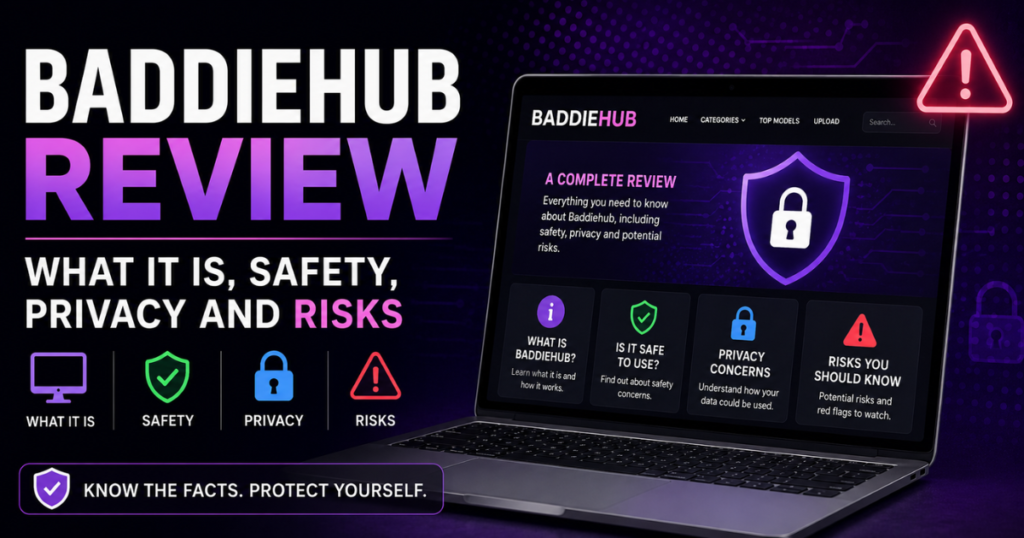
This guide explains what Baddiehub is, what can and cannot be verified, and which privacy, security, copyright, consent, and age-related issues deserve attention. It does not provide instructions for finding, downloading, or redistributing explicit content.
What Is Baddiehub?
Baddiehub is the name associated primarily with an adult-content website. Its homepage presents explicit videos and adult-oriented promotions rather than a general fashion, beauty, or lifestyle community. The site includes browsing categories, a login area, third-party advertising, and a cookie-management panel. Because registration was disabled during the review, readers should not assume that every account or community feature described on other blogs actually exists or remains available.
The keyword is also used by unrelated or lookalike domains. Some of those sites publish fashion articles, generic lifestyle content, or pages designed mainly to capture search traffic. A similar name does not prove shared ownership, authorization, or a formal relationship with the main domain. Users should therefore treat every variation as a separate website and assess it independently.
This ambiguity has created a poor-quality search environment. Numerous articles make unsupported claims about an official app, subscription tiers, verification programs, parental controls, brand dashboards, creator monetization, or a teen-friendly fashion community. Unless a feature can be confirmed on a current official page or reliable documentation, it should not be presented as fact.
Quick answer
Baddiehub is best understood as an adult video website, not as a mainstream social network or fashion platform. It is intended only for adults. Visiting any adult site can involve privacy exposure, tracking, third-party advertising, redirects, copyright questions, and the possibility of encountering deceptive lookalike domains. A secure connection alone does not remove those risks.
Why Are People Searching for Baddiehub?
Searches for Baddiehub reflect more than one intention. Some users want a known website. Others saw the name in a post, suggestion, message, or referral and want an explanation. A third group is checking whether the site is real, safe, free, down, or connected to a creator. Similar domains and generic articles make it easy to click a page run by a different operator.
For publishers, this mixed intent has an important SEO consequence: an article should answer the identity and safety questions immediately. Dressing the keyword up as a fictional “baddie aesthetic” platform may attract an impression, but it fails the user. Google says its systems aim to prioritize helpful, reliable, people-first content rather than pages created mainly to manipulate rankings. Accurate identification is therefore not just an editorial preference; it is the foundation of a credible page.
Is Baddiehub Safe?
There is no honest basis for declaring any website completely safe for every user, device, or moment in time. Website content, advertising partners, scripts, redirects, and domain ownership can change. Automated reputation scores can provide signals, but they are not warranties.
During the August 2026 review, the primary domain loaded through HTTPS and displayed a cookie-consent interface. Those are positive technical observations, but neither proves that every ad, redirect, embedded frame, or external destination is trustworthy. HTTPS encrypts the connection between a browser and the website; it does not certify the quality, legality, or safety of everything delivered through the page.
The main practical concern is the surrounding advertising ecosystem. The homepage contained multiple third-party links and embedded frames. On ad-supported websites, a user may leave the original domain without realizing it. The destination can use different privacy practices, request notification permission, display a fake security alert, or encourage a download.
The U.S. Federal Trade Commission warns that malware can be distributed through websites and ads and may steal information, create unwanted pop-ups, or redirect a browser. That warning is general; it does not prove that Baddiehub itself distributes malware. It does explain why users should judge external ads and redirects separately from the page they first opened.
Warning signs to take seriously
Leave the page if it:
- claims that a device is infected and demands an immediate scan;
- opens repeated tabs or redirects that are difficult to close;
- asks for browser notification access without a clear reason;
- requests a software extension, video player, codec, APK, or executable file;
- imitates an Apple, Microsoft, Google, or antivirus warning;
- asks for payment details on a domain different from the service expected;
- demands login credentials for an unrelated email or social account; or
- uses urgency, countdowns, prize claims, or threatening messages to force a click.
The FTC specifically advises people not to click links or call numbers shown in unexpected pop-up security warnings. Legitimate technology companies do not diagnose a device through a random web advertisement.
Privacy and Tracking Considerations
Privacy is separate from malware. A functional website can still collect an IP address, approximate location, browser type, device information, referring page, viewing activity, and ad interactions. Baddiehub’s visible notice says it stores necessary cookies and may use third-party cookies for analytics. It offers an option to reject non-necessary cookies, but the notice does not explain every third-party script or data flow.
Adult browsing can be especially sensitive because a browsing history, shared-device autocomplete suggestion, synced browser tab, notification, or advertising profile can reveal interests to other people using the device or account. Private or incognito mode is often misunderstood here. It can reduce the local history saved after a session, but it does not make a user anonymous to the website, internet provider, employer, school, network administrator, or every third party embedded on the page.
Users who care about privacy should review browser permissions, reject non-essential cookies when possible, and avoid creating an account with a primary email address. They should never reuse a password from email, banking, work, or social-media accounts. The Cybersecurity and Infrastructure Security Agency also recommends keeping browsers updated, controlling third-party cookies, and managing advertising settings.
Lookalike Domains and Impersonation Risk
One of the clearest risks surrounding this keyword is domain confusion. Search results show multiple sites using Baddiehub or a close variation in the domain name. Some present themselves as fashion blogs. Others appear to discuss or imitate the adult platform. The existence of the name in a URL does not establish authenticity.
Lookalike domains can capture ordinary search traffic, but they may also support phishing, unwanted subscriptions, aggressive ads, or misleading downloads. A padlock is insufficient proof: it confirms an encrypted connection, not that the operator is the company a visitor assumes it is.
Before entering any information, check the full domain character by character. Ignore labels such as “official” unless ownership can be verified independently. Be suspicious of extra words, unusual extensions, misspellings, added hyphens, or pages reached through unsolicited messages. Search-result ads should also be evaluated carefully because a paid position is not an endorsement from the search engine.
Copyright, Consent and Ethical Concerns
Adult-content aggregation raises issues beyond device security. A video being available online does not establish that the person shown agreed to that particular upload, that the uploader owns the rights, or that redistribution is authorized. Content may have been copied from a paid service, reposted without permission, mislabeled, or detached from the creator’s original context.
In the United States, copyright owners generally control reproduction and distribution of their protected work. The U.S. Copyright Office states that uploading or downloading protected material without the owner’s authorization can infringe those exclusive rights. The Digital Millennium Copyright Act also provides a notice-and-takedown process through which rightsholders can ask online service providers to remove allegedly infringing material.
Users should not download, screen-record, repost, sell, or share a person’s content unless they have clear authorization. A watermark, username, or appearance on another website is not permission. The safest ethical standard is simple: use creator-authorized sources, respect paywalls, and do not participate in the circulation of leaked or non-consensual material.
If someone believes their copyrighted content has been posted without authorization, they can document the exact page address, preserve evidence, review the site’s reporting or copyright process, and consider a properly prepared DMCA notice. If intimate material was shared without consent, the issue may also involve state law, platform reporting channels, or specialist victim-support services. Legal rules vary, so affected people may need advice from a qualified attorney rather than relying on a generic blog.
Is Baddiehub Legal in the United States?
The question cannot be answered with a universal yes or no. U.S. law distinguishes between lawful adult material and illegal content, and rules can also vary by state. The legality of viewing, hosting, downloading, or sharing material depends on factors such as age, consent, copyright ownership, the nature of the material, and local law.
Adults should never assume that “available online” means lawful to copy or redistribute. They should also leave and report any material that appears to involve minors, coercion, trafficking, hidden-camera recording, or non-consensual distribution. Do not download or forward suspected illegal material as “evidence”; use the appropriate reporting channel.
This is general information, not legal advice. Specific copyright, privacy, criminal, or removal issues require qualified advice.
Baddiehub and Age Restrictions
Baddiehub contains explicit adult material and is unsuitable for minors. Parents should combine supervised accounts, device or network filters, app-store restrictions, and age-appropriate conversations instead of relying on a basic site warning.
Google explains that SafeSearch is designed to filter explicit sexual content, nudity, and links to pages containing explicit material. However, automated filtering is not perfect. Explicit pages can be mislabeled, new lookalike domains can appear, and content may arrive through social media or messages rather than a conventional search.
Publishers writing about Baddiehub should keep the article educational and non-graphic. They should avoid explicit thumbnails, sensational descriptions, and direct links to explicit pages. Google may classify pages containing explicit text, imagery, or outbound links for SafeSearch. A neutral safety article can still discuss the subject, but presentation and surrounding site content matter.
How to Reduce Risk Before Visiting Any Adult Website
The safest option is not to visit a site that you do not trust. If an adult chooses to access legal adult content, the following precautions reduce common risks without guaranteeing safety:
- Verify the exact domain. Do not follow a shortened link, unsolicited message, or spelling variation.
- Update the browser and operating system. Security patches close known vulnerabilities that malicious ads or scripts may try to exploit.
- Use built-in pop-up and download protections. Do not disable security warnings merely to make a page load.
- Reject unnecessary cookies. Review the consent panel instead of selecting “accept all” automatically.
- Deny notification requests. A video page rarely needs permission to send browser notifications.
- Do not install software. A modern browser should not require a special player, codec, extension, or mobile package to stream ordinary web video.
- Avoid account reuse. If an account is genuinely necessary, use a unique password and an email address not tied to sensitive services.
- Do not enter financial details after a redirect. Confirm the merchant, domain, price, renewal terms, and cancellation process first.
- Do not download or redistribute videos. Availability is not evidence of copyright permission or consent.
- Close the page if behavior changes. Repeated redirects, fake scans, sudden calendar subscriptions, or forced downloads are reasons to leave.
These steps are standard online-safety practices. They should not be interpreted as an endorsement of Baddiehub or any other adult website.
What to Do After a Suspicious Redirect or Pop-Up
If a suspicious page opens, do not interact with it. Close the tab or browser. If it refuses to close, use the operating system’s task manager or force-quit function rather than clicking buttons inside the warning. Do not call a displayed phone number, grant remote access, or install the offered software.
Check the browser’s download list and delete any unrequested file without opening it. Revoke permissions for notifications, camera, microphone, location, pop-ups, and automatic downloads. Remove unfamiliar extensions and run a scan with security software already trusted on the device. If credentials or payment data were entered, use a clean device to change affected passwords and contact the card issuer through its official number or app.
How Baddiehub Differs From Creator-Authorized Platforms
A more trustworthy platform should clearly publish its ownership or operator details, privacy policy, terms of service, age rules, content standards, copyright contact, takedown process, billing terms, and support channel. Those documents do not guarantee perfect behavior, but their absence or inconsistency is a warning sign.
Creator-authorized access also reduces the ethical and legal problems associated with leaked or copied material. People seeking adult content should prefer lawful sources where performers control distribution and receive compensation. Avoid websites or search terms centered on “leaks,” stolen subscriptions, bypasses, or unauthorized downloads.
Frequently Asked Questions
Is Baddiehub a fashion or social-media platform?
The primary baddiehub.com website reviewed in August 2026 is an adult video website. Some unrelated pages use the term for fashion or lifestyle content, but they should not be treated as reliable descriptions of the main domain without evidence of a formal connection.
Is Baddiehub safe to use on a phone?
Using a phone does not eliminate risk. Mobile browsers can still encounter tracking, deceptive ads, notification requests, redirects, phishing pages, and unwanted downloads. Keep the phone and browser updated, deny unnecessary permissions, and never install an app or configuration profile prompted by a random page.
Does Baddiehub have an official app?
No verified official mobile app was identified during this review. Users should be skeptical of APK files, app-store listings, or download pages using the name unless the publisher’s identity can be independently verified. Installing software from an unknown page creates more risk than ordinary browser viewing.
Can content from Baddiehub be downloaded or reposted?
Technical availability does not grant permission. Downloading or redistributing copyrighted material without authorization can infringe the owner’s rights. Reposting intimate content without consent can cause serious harm and may create additional legal exposure. Use only content you have explicit rights to copy or share.
Final Verdict
Baddiehub is an adult-content website surrounded by a confusing ecosystem of lookalike domains and inaccurate articles. Adults researching it should understand that an HTTPS connection or automated trust score is not a complete safety verdict. Privacy tracking, third-party advertising, misleading redirects, account security, copyright, consent, and age restrictions all require separate consideration.
The responsible approach is to avoid unknown copies, reject suspicious downloads and permissions, never reuse important credentials, and refuse to download or share unauthorized intimate material. For publishers, the strongest article is not the one that repeats the keyword most often. It is the one that identifies the service accurately, protects readers from unexpected explicit exposure, uses credible sources, and states clearly what could and could not be verified.