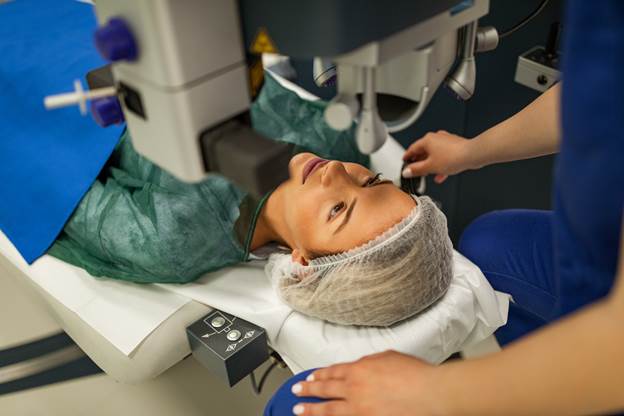
Clear vision plays a major role in how people perform everyday tasks. For individuals who rely on glasses or contact lenses, routine activities like driving, exercising, or working on digital screens can sometimes feel inconvenient. Laser vision correction offers a modern medical approach designed to improve visual clarity and reduce dependence on corrective eyewear.
Laser-based procedures reshape the cornea to correct refractive errors, such as nearsightedness, farsightedness, and astigmatism. By improving how light enters the eye, these treatments allow images to focus properly on the retina, resulting in clearer vision.
For many individuals, laser vision correction can significantly improve daily comfort, convenience, and quality of life.
Understanding Laser Vision Correction
Laser vision correction refers to a group of surgical procedures that reshape the cornea to correct vision problems. The cornea is the transparent front surface of the eye that helps focus incoming light.
When the shape of the cornea causes light to focus incorrectly, vision becomes blurry. Laser procedures correct this issue by precisely adjusting corneal curvature.
Common Vision Problems Treated
Laser vision correction is commonly used to treat:
- Myopia (Nearsightedness): Difficulty seeing distant objects clearly
- Hyperopia (Farsightedness): Difficulty focusing on nearby objects
- Astigmatism: Blurred vision caused by an irregular corneal shape
These refractive errors are among the most common causes of vision impairment worldwide.
Types of Laser Vision Correction Procedures
Several laser procedures are used to improve vision. Each technique may be recommended depending on eye health, corneal thickness, and lifestyle needs.
LASIK (Laser-Assisted In Situ Keratomileusis)
LASIK is one of the most widely performed laser eye surgeries. During the procedure, a thin flap is created on the cornea, and a laser reshapes the underlying tissue to correct vision.
The flap is then repositioned, allowing the eye to heal naturally.
PRK (Photorefractive Keratectomy)
PRK is another laser vision correction method. Instead of creating a flap, the outer layer of the cornea is removed before reshaping the corneal tissue.
The surface layer gradually regenerates during healing.
SMILE (Small Incision Lenticule Extraction)
SMILE is a minimally invasive laser procedure that removes a small piece of corneal tissue through a tiny incision. This technique preserves more corneal structure and may reduce dry eye symptoms for some individuals.
Benefits of Laser Vision Correction in Daily Life
One of the most noticeable benefits of laser vision correction is reduced reliance on glasses or contact lenses. Improved vision can simplify many daily activities.
Greater Convenience
Without glasses or contact lenses, everyday routines become easier. Activities such as waking up in the morning, exercising, or traveling no longer require searching for or managing eyewear.
This convenience can make daily life more comfortable and efficient.
Improved Physical Activity
Sports and outdoor activities usually become easier without glasses or contact lenses.
Running, swimming, cycling, and gym workouts can feel more natural when vision correction does not depend on external lenses.
Athletes and active individuals generally appreciate the freedom that laser vision correction provides.
Enhanced Work Productivity
Many people spend long hours working on computers or digital devices. Contact lenses may cause dryness, and glasses may lead to reflections or discomfort during extended screen use.
Laser vision correction can reduce these issues, allowing individuals to focus more comfortably on work tasks.
People seeking advanced vision care usually explore options in metropolitan areas, and reputed facilities providing LASIK treatment in Mumbai offer modern tools and technology designed to reduce dependence on corrective eyewear.
Clearer Night Vision
Some individuals experience glare, halos, or reflections while wearing glasses at night. Laser vision correction may help improve clarity during nighttime driving and reduce visual disturbances.
However, temporary night vision symptoms can occur during early healing and usually improve over time.
Psychological and Lifestyle Advantages
Beyond physical convenience, improved vision can also affect overall confidence and lifestyle.
Increased Confidence
Many people feel more confident without glasses, especially in professional or social environments. The ability to see clearly without external lenses can improve self-perception and comfort.
Simplified Travel
Traveling with glasses or contact lenses usually requires carrying extra supplies, such as cleaning solutions, spare lenses, or cases.
Laser vision correction reduces these requirements, making travel planning simpler.
Reduced Long-Term Dependence on Eyewear
Although laser surgery does not prevent age-related vision changes, such as presbyopia, it can significantly reduce the need for glasses during everyday activities.
Who May Be a Suitable Candidate for Laser Vision Correction?
Not everyone is eligible for laser vision correction. Eye specialists evaluate several factors before recommending the procedure.
Basic Eligibility Criteria
Candidates generally:
- Are over 18 years old
- Have a stable vision for at least one year
- Have healthy corneas
- Do not have certain eye diseases
A comprehensive eye examination helps determine whether the procedure is appropriate.
Situations Where Laser Vision Correction May Not Be Recommended
Certain conditions may limit eligibility, including:
- Severe dry eye syndrome
- Thin corneas
- Uncontrolled diabetes
- Advanced glaucoma or cataracts
In such cases, alternative vision correction methods may be recommended.
What to Expect During the Procedure
Laser vision correction procedures are normally quick and performed on an outpatient basis.
Before the Procedure
An eye specialist performs detailed measurements of the cornea, pupil size, and refractive error to plan the treatment.
Patients may be advised to stop wearing contact lenses before the evaluation to ensure accurate measurements.
During the Procedure
The surgery usually takes less than 30 minutes. Numbing eye drops are applied to reduce discomfort.
Patients remain awake but may experience mild pressure during the procedure.
After the Procedure
Vision usually improves within a few days, although complete stabilization may take several weeks.
Common temporary symptoms include:
- Mild irritation
- Sensitivity to light
- Blurred vision during healing
Doctors usually recommend eye drops and follow-up visits to monitor recovery.
Potential Risks and Considerations
Laser vision correction is generally considered safe, but like any medical procedure, it carries certain risks.
Possible side effects may include:
- Temporary dry eyes
- Visual glare or halos
- Under-correction or over-correction
- Rare infection or inflammation
Most complications are uncommon and can usually be managed with proper follow-up care.
Discussing expectations and medical history with an eye specialist is essential before deciding on surgery.
Frequently Asked Questions
Is laser vision correction permanent?
Laser vision correction permanently reshapes the cornea. However, natural aging of the eye may still affect vision over time.
How long does recovery take?
Many individuals notice improved vision within a few days. Full stabilization may take several weeks depending on the procedure.
Is the procedure painful?
Laser eye surgery is generally painless because numbing eye drops are used during the procedure.
Can both eyes be treated at the same time?
Yes. In most cases, both eyes are treated during the same session.
Will glasses ever be needed again?
Some individuals may still need glasses later in life, especially for reading as part of natural aging.
Conclusion
Laser vision correction has transformed the way many people manage refractive errors. By reshaping the cornea, these procedures help improve visual clarity and reduce reliance on glasses or contact lenses.
From simplifying daily routines to supporting active lifestyles, clearer vision can positively affect both comfort and independence. For individuals considering vision correction, consultation with a qualified eye specialist helps determine the most appropriate treatment option based on eye health and personal needs.