You can have a sleek UI and a robust catalogue, but if your platform does not offer speed, personalization, and flexibility at scale, users will click away.
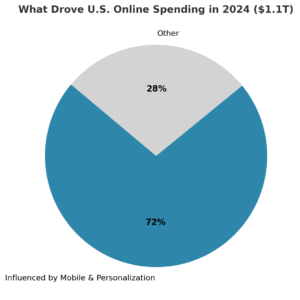
American shoppers spent over $1.1 trillion online in 2024, with more than 72% of those transactions influenced by mobile devices and personalized experiences (Adobe, Shopify, Statista). In 2025, the bar for eCommerce excellence is higher and evolving rapidly. From AI-driven discovery to privacy-first compliance, users expect more, delivered faster.
This guide breaks down the 10 mission-critical features every U.S.-focused eCommerce platform must integrate to stay competitive. Not trends—these are non-negotiables for performance, conversion, and retention.
10 Must-Have Features for High-Performance eCommerce Web Apps in 2025
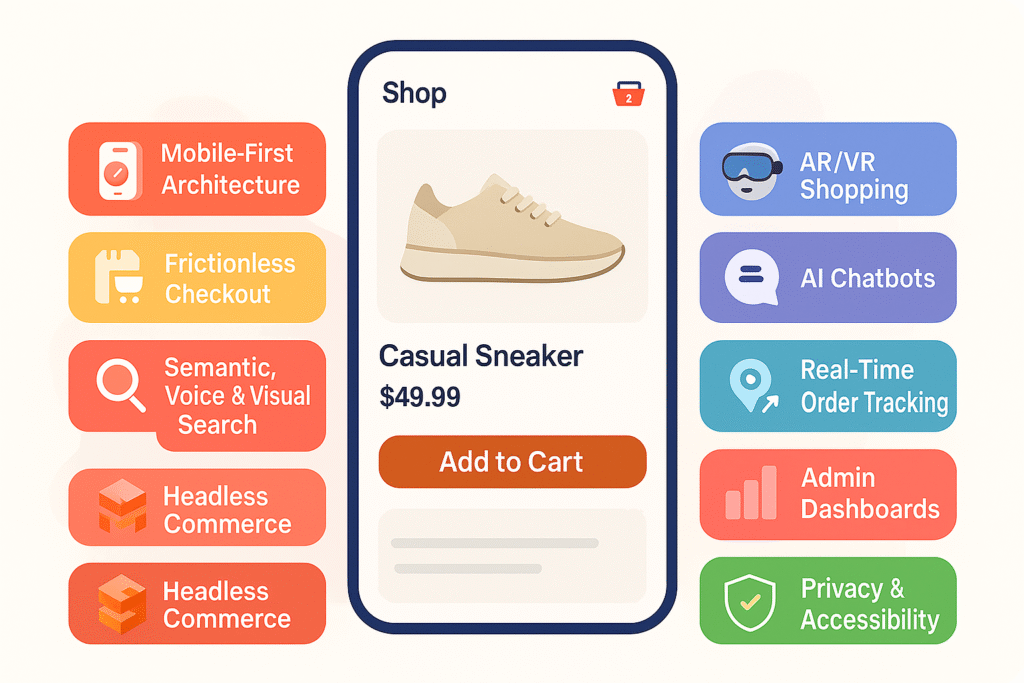
In a landscape where shoppers bounce in seconds and loyalty hinges on experience, building an eCommerce app isn’t about stacking features—it is about integrating the right ones. Below is a breakdown of the 10 most critical capabilities every modern U.S.-focused eCommerce platform must deliver to compete—and win—in 2025.
1. Mobile-First Architecture with Sub-Second Load Speeds
Fast is not a bonus feature. It’s the baseline for entry. For most U.S. consumers, the mobile browser is the storefront. If your app does not load quickly or render cleanly, you lose the sale before the page finishes loading. Research shows that every additional second of delay cuts conversions by 7%—and that is across industries, not just retail.
To meet the expectation of near-instant speed, modern platforms are leaning into Progressive Web Apps (PWAs), CDN-first delivery (e.g., Cloudflare, Fastly), and frameworks like Next.js for server-side rendering with caching. Lazy loading assets and minimizing JavaScript bloat are essential steps—not optimizations.
2. AI-Powered Personalization at Every Touchpoint
Generic storefronts do not convert—they leak intent. Leading eCommerce platforms now deploy real-time personalization pipelines that adapt the site architecture based on behavioral telemetry, not assumptions.
Modern personalization engines leverage multi-touch user graphs to trigger in-session optimizations. Think dynamic product sequencing, personalized pricing tiers, and micro-targeted offers—all shaped by vectorized user intent models.
On the engineering side:
- Event stream processing tools (Kafka, Segment) collect granular signals like scroll velocity, pause time on product cards, search modifiers, and cart edit frequency.
- These signals feed into real-time feature stores (Feast, Redis), enabling edge delivery of personalized experiences without adding latency.
- Model inference happens server-side or at the CDN edge (using Vercel Functions or AWS Lambda@Edge) to surface:
- Frequently co-viewed items
- Time-sensitive recommendations (e.g., weekend discounts on fitness gear)
- Personalized search sorting based on past conversions
These systems rely on zero- and first-party data to comply with U.S. privacy regulations. Instead of over-relying on PII, they extract meaning from behavioral vectors—such as hover patterns and abandonment points—to adjust the funnel dynamically.
The result? Platforms that implement these pipelines see 20–30% higher AOVs, reduced bounce rates, and repeat visits that are 2.5x more likely to convert.
3. Frictionless Checkout with BNPL and Express Payments
Cart abandonment is rarely emotional. It’s logistical. Long forms, limited payment options, unclear fees—these are what push shoppers away.
U.S. platforms that have embedded Buy Now, Pay Later (BNPL) solutions such as Klarna or Affirm, enabled wallet integrations (Apple Pay, Google Pay), and simplified tax/shipping calculations are seeing a tangible drop in abandonment rates.One-click checkout now defines the benchmark for seamless digital buying experiences across the retail landscape.
The most effective checkout flows reduce clicks, offer flexibility, and eliminate the cognitive load that stalls a purchase.
4. Semantic, Voice & Visual Search for Instant Discovery
Purchase journeys in 2025 begin with intent—search must translate that into precision and relevance, instantly.
Modern eCommerce platforms are implementing AI-enhanced search systems that support semantic parsing, real-time suggestions, voice input, and even visual lookup via camera or screenshot. These engines bridge shopper intent with structured catalog data, enabling relevant results even when queries are vague, incomplete, or typo-ridden.
The best search experiences feel predictive, not reactive—removing friction entirely from the path to product discovery.
5. Headless Commerce for Omnichannel Continuity
The modern buying journey is fluid—browsing may begin on mobile, continue on desktop, and conclude in-app or at a physical store. Delivering a coherent experience across this mosaic of touchpoints requires more than responsive design; it calls for architectural agility.
Headless commerce provides that agility by decoupling the frontend from backend systems, enabling API-first flexibility. This architecture empowers retailers to maintain session continuity, push updates across channels instantly, and personalize content independently of the underlying infrastructure.
U.S. platforms leveraging headless stacks—like Shopify Hydrogen and BigCommerce APIs—are accelerating release cycles, reducing technical debt, and delivering consistent UX across web, mobile, and retail.
Headless is not a trend—it is the infrastructure backbone for omnichannel scalability.
6. Immersive AR/VR Shopping to Build Buyer Confidence
As product categories get more tactile—furniture, fashion, electronics—static images fall short. Consumers want to see, rotate, try, and test before they commit.
Augmented and virtual reality experiences are solving that trust gap. Web-based 3D viewers, AR room previews, and virtual try-on features (for glasses, shoes, makeup, etc.) reduce hesitation and lower return rates. According to Deloitte, more than 60% of shoppers say AR boosts their purchase confidence.
AR/VR brings tangibility to digital shopping—bridging the gap between screens and real-world confidence.
7. Intelligent AI Chatbots That Enhance Experience
Modern eCommerce platforms are embedding conversational AI directly into the shopping experience—transforming support from a reactive function into a proactive growth driver.
These intelligent chatbots guide users through product discovery, assist with comparisons, track orders in real time, and provide contextual answers across channels. With seamless escalation paths to human agents, they maintain continuity and confidence throughout the journey.
In a market where 24/7 responsiveness defines customer loyalty, top U.S. retailers are using AI-powered chat to boost resolution rates, reduce load on support teams, and elevate the purchase experience.
More than answering queries, these bots enhance conversion by understanding behavior and nudging users at key decision points.
8. Real-Time Order Tracking with Predictive Updates
Post-purchase UX is a retention lever. Transparency builds confidence—and keeps customers coming back.
Once a transaction is complete, the focus shifts to trust through communication. Order-related queries, especially “Where is my order?”, remain the most frequent in retail support. The solution is not more agents—it’s smarter systems.
Leading platforms now integrate deeply with logistics APIs like EasyPost, FedEx, and UPS to offer real-time tracking, predictive ETAs, and automated updates across SMS, email, and in-app notifications.
Rather than displaying a basic tracking map, these systems eliminate uncertainty by proactively informing users of status changes—reducing WISMO (Where Is My Order) tickets and reinforcing satisfaction in the post-purchase phase.
9. Admin Dashboards with Embedded Intelligence
Every decision-maker needs clarity, not clutter. Modern dashboards now deliver real-time insights that drive growth, retention, and operational efficiency.
Operators today rely on actionable intelligence to answer key questions: Which funnel stage needs attention? Which campaign is boosting LTV? Where are the early signs of inventory strain?
Advanced admin panels are built with embedded analytics tools like GA4, Mixpanel, and Looker Studio—offering precise attribution, user segmentation, and predictive inventory metrics.
These systems are not built for data analysts alone—they are designed to empower product heads, marketing leads, and ops managers to act swiftly and with confidence. Smart dashboards surface the right signals, at the right time, to accelerate business outcomes.
10. Privacy-First, ADA-Compliant, and Trust-Centric Design
Trust is now a feature. Platforms that prioritize user rights—from data privacy to accessibility—build stronger, more loyal relationships.
In the U.S., frameworks like CPRA, ADA, and FTC guidelines are setting a higher bar for ethical design. Leading platforms are implementing built-in support for keyboard navigation, screen reader compatibility, high-contrast UI modes, dynamic cookie controls, and opt-in personalization settings.
This isn’t just about compliance—it’s about creating digital experiences that are inclusive, respectful, and future-ready. By embedding privacy and accessibility into the core product architecture, eCommerce brands expand their audience, enhance usability, and reinforce long-term trust.
Challenges & How Top Builders Are Solving Them
| Challenges | Solutions |
| Performance vs Feature Overload | Micro-frontends, code splitting, edge caching |
| High Build Costs for AI/AR | Open-source SDKs, phased rollouts, API-first plugins |
| Regulatory Complexity (ADA, CPRA) | Pre-audited libraries, compliance-as-a-service (e.g., Vanta) |
| Integration Fatigue with APIs | API gateways and service orchestration (e.g., Temporal, Kong) |
What Comes Next?
What’s ahead for eCommerce is not speculative—it is already unfolding. Voice-first commerce will extend beyond convenience, enabling seamless transactions via Alexa and Siri. Agentic AI systems will autonomously manage upselling, cart recovery, and personalized re-engagement. Blockchain is emerging as a key enabler of transparent, tamper-proof supply chains, particularly in luxury and pharma. Meanwhile, inventory-aware search will dynamically adjust results based on real-time stock availability, ensuring that discovery aligns with operational reality. The next wave is intelligent, responsive, and infrastructure-aware.
How Emerging U.S. Firms Are Revolutionizing eCommerce with Modern Web App Solutions
If you are not building in-house, the partner you choose could determine how far you scale—or stall. Here are the U.S.-based firms leading the next phase of eCommerce engineering:
1. GeekyAnts Inc., San Francisco, USA
Specialization: React Native, Flutter, full‑stack mobile & web development
Website: www.geekyants.com/en‑us
With nearly two decades of product engineering leadership, GeekyAnts delivers scalable, high-performance custom eCommerce web applications. Their cross-platform prowess accelerates development without compromising UX.
eCommerce Capabilities:
- Custom shopping cart engines with promo logic and abandonment flows
- Dynamic catalogs featuring smart variant mapping and search filters
- Real-time inventory sync across warehouses
- Deep 3PL connectivity (Shiprocket, FedEx, EasyPost) with integrated payment gateways
Why They Stand Out:
- MVP launches within weeks, not months
- Strong API integration across fintech, logistics, CRM systems
- Seamless design-to-deployment workflows supporting both D2C and B2B
- Clutch Rating: ★ 4.9/5 from 100+ verified reviews
Location & Contact:
315 Montgomery Street, 9th & 10th Floors, San Francisco, CA 94104 · +1 845 534 6825 · info@geekyants.com
2. DCKAP, Austin, Texas
Specialization: ERP-linked eCommerce, B2B commerce workflows
Clutch Rating: ~4.6/5
DCKAP bridges eCommerce and enterprise logistics for distributors and manufacturers. Their proprietary Integrator platform synchronizes ERP, CRM, inventory, logistics, and marketplace systems.
eCommerce Strengths:
- ERP-backed storefronts with automated order/inventory sync
- Scalable microservices and PIM-driven catalog management
- Tailored cross-border and wholesale commerce solutions
Trusted by mid-market U.S. brands, DCKAP shines when eCommerce needs to coexist within complex B2B networks.
3. Zivtech, Philadelphia, Pennsylvania
Specialization: Open-source platforms, custom web applications
Clutch Rating: ~4.5/5
Zivtech empowers mission-driven commerce brands with bespoke open-source solutions. Whether building for Drupal, Laravel, or headless frameworks, they merge accessibility, performance, and long-term sustainability.
eCommerce Capabilities:
- Custom CMS and eCommerce integrations
- Performance-optimized storefronts with mobile-first architecture
- Accessibility-first code and SEO-ready deployments
Perfect for organizations that need full control over their technology stack without vendor lock-in.
Final Takeaways
Winning in eCommerce today means engineering for precision, not excess. The most successful platforms combine performance, personalization, and compliance into seamless digital journeys. Whether you’re building in-house or partnering with forward-thinking firms, every capability must align with evolving shopper expectations and operational agility. With AI, AR, and headless systems now standard, the next frontier will reward those who design with intelligence, adapt in real time, and treat trust, speed, and scalability as foundational principles—not features.