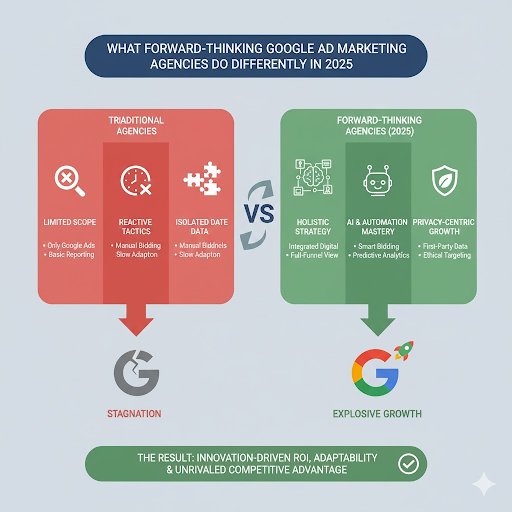
A manufacturing company owner complained to me yesterday about their agency still using tactics from 2023. They were running broad match keywords without Smart Bidding, ignoring Performance Max campaigns entirely, and hadn’t implemented enhanced conversions despite Google pushing it for two years. When platform updates happened, the agency took months adapting—if they adapted at all. Meanwhile, competitors using forward-thinking agencies implementing cutting-edge strategies were capturing market share with superior efficiency. The gap wasn’t just technical—it was fundamental to how agencies approached the platform’s continuous evolution.
This gap between agencies stuck in the past versus those embracing platform evolution determines whether campaigns thrive or slowly become obsolete as Google Ads continues advancing. The difference compounds monthly as modern tactics pull further ahead of outdated methods that once worked but now underperform dramatically.
The Platform Evolution Reality
Here’s what separates modern agencies from those becoming obsolete: the willingness to embrace platform changes rather than resisting them. Google Ads has transformed dramatically over recent years—from manual keyword management to AI-powered automation, from siloed campaign types to integrated Performance Max, from basic conversion tracking to sophisticated attribution modeling. Agencies that adapt quickly thrive, while those clinging to outdated methods slowly fail.
The shift toward AI-powered optimization represents the biggest change affecting campaign management fundamentally. Smart Bidding strategies like Target CPA, Target ROAS, and Maximize Conversions now outperform manual bidding in most scenarios by processing millions of signals per auction that humans simply can’t analyze. Forward-thinking agencies embrace these automation tools, configuring them properly with clean data and realistic targets rather than fighting against algorithmic optimization.
Manual bidding still has specific use cases—brand campaigns with highly predictable performance, very small budgets insufficient for algorithm learning, or situations requiring absolute bid control. But treating manual as default while viewing Smart Bidding skeptically indicates agencies haven’t adapted to platform realities. Modern agencies default to Smart Bidding, reserving manual only for situations where automation genuinely underperforms.
Performance Max campaigns reaching across Search, Shopping, Display, YouTube, Gmail, and Discover from unified setups deliver 13% more conversions at similar costs compared to channel-specific approaches when configured correctly. Yet many agencies avoid Performance Max because it requires different expertise than traditional campaign management. They can’t micromanage keywords and bids the way they’re comfortable doing, so they resist despite superior results.
Modern agencies have mastered Performance Max setup—comprehensive asset libraries with multiple headlines, descriptions, images, and videos in various formats, strategic audience signals guiding AI toward valuable segments, proper conversion tracking feeding clean data, and appropriate guardrails like negative keywords ensuring AI works toward business goals. This expertise transforms Performance Max from mysterious black box into high-performing campaign type.
Audience-first strategies replacing keyword-obsessed approaches reflect another major evolution. While keywords still matter for capturing intent, modern campaign success comes from understanding customer segments, leveraging first-party data through Customer Match, and building remarketing audiences that capture high-intent prospects at various journey stages. The agencies still adding thousands of keyword variations while ignoring audience opportunities miss how the platform actually works now.
Enhanced conversion tracking and privacy-compliant measurement became critical as third-party cookies disappear and privacy regulations tighten. Agencies implementing enhanced conversions, consent mode, and first-party data strategies maintain measurement accuracy while competitors struggle with data gaps preventing proper optimization. This isn’t optional anymore—it’s foundational to campaign success.
Responsive Search Ads replacing traditional expanded text ads required adapting to Google’s AI generating ad combinations rather than manually controlling every variation. Modern agencies write headlines and descriptions designed for algorithmic mixing, understanding how to seed AI with strategic messaging rather than trying to micromanage exact ad copy. They provide 10-15 headlines and 3-4 descriptions knowing Google will test combinations finding what works best.
The Strategic Adaptation Framework
This is where understanding what a google ad marketing agency actually does to stay current becomes critical. The best agencies don’t just react to platform changes—they anticipate them, test innovations early, and implement strategically rather than haphazardly.
Continuous education keeps teams current with platform evolution. Modern agencies invest heavily in training—certifications, advanced courses, beta program participation, and industry conference attendance. This knowledge investment ensures teams understand new features deeply rather than implementing superficially based on blog posts. The annual Google Marketing Live conference reveals major updates months before general availability. Agencies attending and immediately testing announced features maintain 3-6 month advantages over those waiting for documentation.
Early adoption of platform innovations provides competitive advantages before features become mainstream. Agencies in Google’s beta programs test Performance Max, AI-generated assets, and new bidding strategies months before general availability, determining what works across multiple client accounts. This early learning means they implement confidently while competitors are still reading documentation. The pattern repeats with every major feature—early adopters learn fast, implement successfully, and capture advantages before features commoditize.
Testing frameworks separate agencies that genuinely optimize from those just maintaining campaigns. Modern agencies systematically test new features, bidding strategies, audience approaches, and creative variations. They measure results rigorously, implement winners, and document learnings across their client portfolio. This structured experimentation compounds advantages over time as successful tests get implemented while failures get abandoned quickly.
The testing mindset extends beyond just platform features into strategic approaches. Should budgets shift toward Performance Max or maintain traditional Search campaigns? Does audience layering improve targeting precision or unnecessarily restrict reach? Will AI-generated assets perform better than manually created ones? Modern agencies test these questions systematically rather than guessing based on conventional wisdom that might be outdated.
Account structure evolution reflects platform changes rather than defending outdated approaches. The single-keyword ad groups that were best practice five years ago now segment data unnecessarily in AI-driven campaigns. Modern agencies adjust structures matching current platform realities—themed ad groups for Smart Bidding, comprehensive asset libraries for Performance Max, and audience layering for precision targeting.
Data quality obsession enables AI optimization. Agencies achieving breakthrough results ensure conversion tracking captures accurate signals, transaction values flow properly for revenue optimization, and attribution models match customer journey complexity. Without clean data, even sophisticated AI optimizes toward nonsense—garbage in, garbage out applies fully to algorithmic campaigns.
The data foundation includes enhanced conversion tracking capturing additional signals even when cookies are blocked, server-side tagging improving accuracy and reliability, consent mode maintaining measurement while respecting privacy choices, and offline conversion imports connecting digital advertising to in-store or phone sales. This comprehensive data infrastructure separates agencies building for current platform realities versus those using tracking methods from five years ago.
The Integration Mindset That Multiplies Results
Working with a comprehensive best google ads agency provides integrated strategies coordinating multiple channels rather than siloed tactics. The platform evolution enables unprecedented coordination across touchpoints when agencies think holistically.
Cross-channel campaigns leveraging Performance Max reach customers across Search, Shopping, Display, YouTube, and Discovery simultaneously. Modern agencies configure these campaigns with strategic audience signals from email lists, website visitors, and CRM data guiding AI toward valuable segments. The machine learning algorithms identify patterns across channels humans would never spot—which YouTube viewers convert best through Search ads, how Display impressions influence Shopping behavior, which Discovery audiences show highest purchase intent.
The integration with Google Ads automation and strategies across platforms like Facebook advertising creates comprehensive customer journey coverage. Prospects might discover brands through Facebook awareness campaigns, research through Google Search, engage through YouTube videos, and convert through Shopping ads. Coordinating messaging and measurement across this journey reveals attribution insights siloed channel management misses entirely.
First-party data strategies utilizing Customer Match enable targeting existing customers for upselling, creating lookalike audiences finding similar prospects, and excluding current customers from acquisition campaigns. Agencies leveraging CRM integration maintain competitive advantages as third-party targeting options diminish with cookie deprecation. The businesses with robust first-party data collection and activation strategies will dominate advertising as privacy changes eliminate traditional targeting methods.
Remarketing sophistication goes far beyond basic “visited my website” lists that were standard practice years ago. Modern agencies segment by specific behaviors—product page viewers getting messaging highlighting those specific products, cart abandoners receiving offers incentivizing completion, high-value customers seeing premium product promotions, engaged email subscribers getting coordinated messaging across channels. This behavioral segmentation converts dramatically better than generic remarketing treating all past visitors identically.
Dynamic remarketing for ecommerce takes personalization further by automatically showing specific products people viewed alongside similar recommendations. Someone who browsed leather jackets sees ads featuring those exact jackets plus complementary items like boots or bags. This product-specific messaging converts far better than generic brand ads.
Attribution understanding informs budget allocation across channels based on actual contribution rather than simplistic last-click assumptions. While last-click attribution oversimplifies customer journeys by crediting only final touchpoints, data-driven attribution distributes credit based on actual contribution patterns revealed through machine learning analysis of conversion paths. Agencies analyzing attribution properly make smarter investment decisions about which channels deserve more budget and which get overvalued through attribution bias.
Landing page integration with broader website strategies ensures consistency while maximizing conversions. Modern agencies don’t create standalone landing pages disconnected from brand experiences—they develop coordinated journeys from ad click through conversion and post-purchase nurturing. The messaging consistency, visual alignment, and seamless user experience from ad through landing page through checkout dramatically improves conversion rates compared to disjointed experiences.
The Competitive Advantage Platform Mastery Provides
The gap between agencies embracing platform evolution versus those resisting it continues widening as Google Ads advances faster than ever. Modern features deliver substantial advantages—13% more conversions from Performance Max when configured properly, 30-50% cost reductions through Quality Score optimization, 25-40% better results from integrated multi-channel approaches coordinating all touchpoints.
Businesses partnering with forward-thinking agencies benefit immediately from expertise staying current with continuous platform changes. The alternative is working with agencies using three-year-old tactics that were effective then but underperform now as Google Ads has evolved substantially. The performance gap compounds monthly—modern tactics pull 5-10% ahead initially, but that advantage grows to 30-50% within a year as outdated methods degrade while current approaches improve.
Smart businesses recognize platform expertise as fundamental to agency value beyond just general PPC knowledge. They ask potential partners about their approach to Performance Max—do they use it, how do they configure it, what results have they achieved? They inquire about AI-powered bidding strategies—which situations warrant Smart Bidding versus manual, how do they set targets, what data requirements exist? They explore first-party data strategies—how do agencies leverage Customer Match, what audience segmentation approaches do they use, how do they prepare for cookie deprecation?
These questions reveal whether agencies think strategically about platform evolution or just defend comfortable old methods because learning new approaches requires effort. The agencies confidently explaining modern tactics with specific examples demonstrate current expertise. Those deflecting questions or dismissing new features as “not ready yet” reveal outdated thinking that will undermine campaign performance.
The transformation happening in Google Ads demands agencies that embrace change, test innovations systematically, and implement strategically rather than reactively. The businesses thriving partner with agencies possessing this forward-thinking mindset rather than those stuck perpetuating outdated approaches in rapidly evolving platforms.
Campaign success in 2025 and beyond requires expertise businesses either develop internally through years of continuous learning or access immediately through partnerships with agencies already mastering platform evolution. The choice determines whether advertising becomes increasingly effective growth engine leveraging cutting-edge capabilities or slowly declining channel as competitors leveraging modern strategies pull ahead through superior efficiency.