The universal testing machine (often referred to simply as a universal test machine or UTM) is the single most important instrument in any materials testing laboratory. It is the gold standard for quantifying how materials behave under stress, providing the critical data necessary for quality control, engineering design, and safety compliance across every major industry.
But what is a universal testing machine? In simplest terms, it is a versatile electromechanical system designed to apply force (tension or compression) to a material sample and measure the resulting physical change (elongation, deformation, or fracture). Because of this versatility, it is often called a universal tensile testing machine or a universal machine testing system.
This guide provides a comprehensive overview of the UTM, its operational principles, and how this vital equipment is used to ensure the reliability of products from medical implants to structural steel.
Operational Principles of Universal Testing Machines
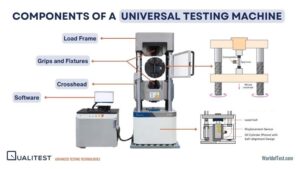
A universal testing machine operates on the principle of applying controlled, measured force via crossheads, which are precisely moved using electromechanical drives or hydraulic power.
Core Components
- Load Frame: The rigid structure that provides the framework for the test. It includes columns and a base that maintain alignment during high-force testing.
- Crosshead: The movable component that travels along the vertical axis of the load frame to apply tension or compression to the specimen. Its speed must be controlled with extreme precision.
- Load Cell: The sensor that measures the force (load) applied to the specimen. Load cells are interchangeable, allowing a single universal testing machine to accurately measure forces ranging from a few Newtons (for fragile films) to thousands of kilonewtons (for steel bars).
- Extensometer: A device attached directly to the specimen to precisely measure the change in length (strain) or displacement during the test.
- Digital Controller and Software: The brain of the system, which controls the crosshead speed, records data from the load cell and extensometer, and plots the resulting stress-strain curve.
The majority of modern UTMs, like the universal instron testing machine systems, utilize electromechanical drives because they offer superior control over speed and displacement compared to older hydraulic systems, especially at lower load ranges and when performing cyclical (fatigue) testing.
Key Testing Modes and Applications
The term “universal” refers to the UTM’s ability to perform multiple fundamental mechanical tests simply by changing the fixturing and software parameters.
1. Tensile Testing
Tensile testing is the most common application, providing data crucial for understanding a material’s strength and ductility. The test involves securing the specimen (e.g., a plastic dumbbell, metal rod, or wire) between two grips and pulling it apart until failure.
A universal tensile testing machine system accurately measures:
- Ultimate Tensile Strength (UTS): The maximum stress the material can withstand.
- Yield Strength: The point at which the material begins to deform permanently.
- Elongation: The percentage increase in length before failure, indicating ductility.
The universal testing machine for tensile test is vital for quality control in industries manufacturing everything from textiles to aerospace fasteners. The tensile test on universal testing machine provides the foundational stress-strain data needed for material specification.
2. Compression Testing
Compression testing determines a material’s behavior when a crushing load is applied. The universal testing machine compression test is crucial for analyzing brittle materials and components that must bear heavy loads.
The universal testing machine for compression test is typically used to measure:
- Compressive Strength: The maximum stress sustained under crushing load.
- Modulus of Elasticity: The material’s stiffness.
This mode is essential for quality control in civil engineering (concrete, ceramics) and packaging (crush resistance of boxes).
3. Flexural Testing (Bending)
Flexural (or bending) tests quantify a material’s resistance to deformation under bending stress. This test is highly relevant for materials used as beams or supports.
In a common three-point bend test, the universal tensile strength testing machine applies force to the center of the specimen while the ends are supported. This measurement is widely used for:
- Plastics and Composites: Assessing stiffness and resistance to fracture.
- Wood and Ceramics: Determining the breaking point under applied load.
System Configuration and Selection
Choosing the correct UTM requires a careful balance of budget, material type, and testing needs.
Hydraulic vs. Electromechanical Systems
- Electromechanical UTMs: Ideal for high-precision, low-to-medium force applications (up to ~300 kN). They offer precise speed control and are commonly used as universal tensile test machine systems for plastics, composites, and biomedical devices.
- Hydraulic UTMs: Are built for massive forces (up to 2,000 kN or more). They are cost-effective for static testing of structural materials like concrete, thick steel plate, and rebar, though they offer less control at very low speeds.
Accessories and Fixturing
The versatility of the universal testing machine is heavily reliant on its tooling. Investing in universal testing machine accessories is necessary to broaden the machine’s capabilities. These accessories include:
- Grips: Pneumatic grips for films and textiles; wedge grips for metals; vice grips for rigid plastics.
- Environmental Chambers: Used to test materials at non-ambient temperatures (hot or cold) to simulate real-world conditions.
- Extensometers: Optical or clip-on devices for accurate strain measurement.
- Compression Platens and Bend Fixtures: Required for non-tensile tests.
Advanced Automation
For labs with high throughput, automation is key. Fully universal / tensile testing machine systems now integrate robotic sample handling, automatic measurement devices (like optical extensometers), and specialized software. This allows the universal machine testing process to run continuously, minimizing human error and maximizing sample rate. An automated optical comparator may even be integrated for post-test dimensional analysis.
Ensuring Accuracy and Compliance
All universal testing machines must be regularly calibrated to ensure the force and displacement readings are accurate. Compliance is generally governed by international and national standards:
- ASTM (American Society for Testing and Materials): Provides the specific test methods, such as ASTM D638 for plastic tensile testing or ASTM E8 for metal tensile testing. These methods dictate the specimen shape, testing speed, and reporting requirements.
- ISO (International Organization for Standardization): Provides parallel international standards (e.g., ISO 527 for plastics).
Whether you are performing a universal testing machine for compression test on foam or a universal testing machine for tensile strength on aluminum, adherence to these standards is mandatory for reliable product certification and validation. Ultimately, the universal testing machine provides the objective data necessary to ensure that products are built to perform under pressure.
Explore Your Testing Capabilities
Are you looking to upgrade your laboratory with high-precision force testing systems? Explore the extensive range of universal testing machine systems, universal / tensile testing machine systems, and universal testing machines at the Qualitest or WorldofTest website. They offer solutions for every application, from basic universal tensile test machine functionality to fully automated, high-capacity systems.