For years, the “Holy Grail” of consumer 3D printing was simple: the ability to print in color without spending thousands of dollars on industrial machinery. We wanted to move beyond monochrome benchies and grey prototypes into a world of vibrant, multi-colored models.
Today, that dream is a reality. Multi-color printing is accessible to almost anyone with a desktop setup. However, as many excited hobbyists have discovered, this new capability comes with a “dirty little secret” that rarely makes it onto the box art: waste.
If you have spent any time on 3D printing forums recently, you have likely seen the photos. A user shows off a beautiful, four-color dragon model that weighs 150 grams. Next to it sits a tangled, chaotic pile of “filament poop”—the purged waste material—that weighs 200 grams.
This inefficiency is changing how consumers evaluate their hardware. The conversation is shifting from “Can it print in color?” to “Can it print in color efficiently?” Here is why the next generation of independent extruder technology is poised to make the “purge tower” a thing of the past.
The Hidden Cost of the Single Nozzle
To understand why waste occurs, we have to look at how most current consumer multi-material systems operate.
The majority of popular multi-color attachments use a single nozzle. To change colors, the printer must cut the filament, retract it, load the new color, and then push the new filament through the hot nozzle. Because the nozzle still contains residue from the previous color (e.g., black), you cannot immediately start printing with the new color (e.g., white), or you will get a muddy grey.
The printer solves this by “purging” or “flushing.” It extrudes a calculated amount of the new filament into a waste chute or a “purge block” until the color runs clear. It does this for every single color change on every single layer.
If you are printing a model with 500 layers and two color changes per layer, the printer is performing this wasteful cycle 1,000 times. This results in:
- Financial Loss: You are literally melting money. For complex colorful prints, it is not uncommon for the waste material to cost more than the object itself.
- Environmental Impact: While PLA is biodegradable under specific industrial conditions, generating kilograms of plastic waste for aesthetic prints is difficult to justify for the eco-conscious maker.
The Shift to Independent Toolheads
The solution to the waste problem isn’t better software or smarter purging algorithms—it is hardware evolution. The industry is seeing a resurgence and refinement of tool changer systems.
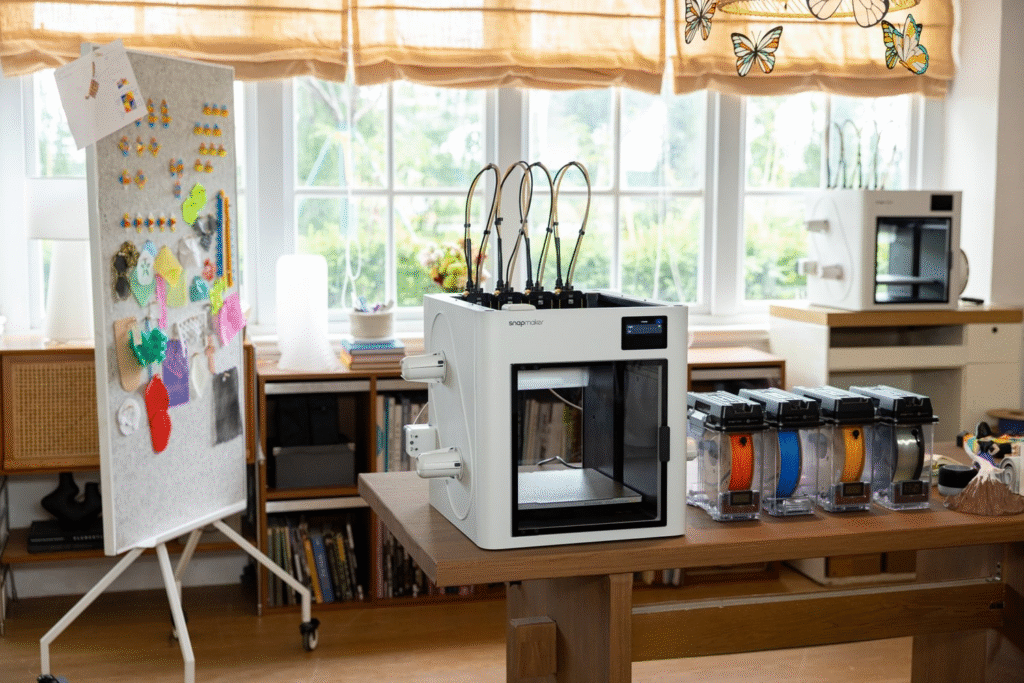
Unlike single-nozzle systems that force multiple filaments through one choke point, a modern multi color 3d printer designed for efficiency utilizes independent toolheads. In this setup, each color or material has its own dedicated nozzle.
When the printer needs to switch from blue to red, the “blue” head simply parks itself to the side, and the “red” head moves in to continue printing. There is no cutting, no retracting, and crucially, no purging. The nozzle is already primed with the correct color.
Time is Money (and Electricity)
The benefits of eliminating the purge cycle extend beyond just saving plastic. They also save a tremendous amount of time.
In a single-nozzle system, the swap sequence (cut, retract, load, purge, wipe) can take anywhere from 40 to 90 seconds depending on the machine and settings. If your print has hundreds of color swaps, you are adding hours—sometimes days—to the total print time.
An independent extruder system can switch heads in a fraction of a second. This drastically reduces the total energy consumption of the machine (since it isn’t running heaters and motors for hours of non-printing time) and allows makers to iterate on their designs faster. For a hobbyist running a small print farm or an Etsy shop, this time efficiency translates directly into higher throughput and profit margins.
Beyond Aesthetics: The Material Advantage
While “color” is the headline feature for consumers, the true power of independent extruders lies in material compatibility.
Single-nozzle systems rely on a generic temperature range for the “flush.” However, if you try to mix materials with vastly different melting points or chemical properties—like PLA (rigid) and TPU (flexible), or PLA and PETG—you run a high risk of jamming the nozzle. The residue of the higher-temp material can crystalize and block the lower-temp material.
With a dedicated toolhead for each material, cross-contamination is impossible. This makes a capable color 3d printer a powerful functional tool. You can print a mechanical part in robust PETG while using a completely different material for “break-away” supports. Since the interface material doesn’t need to be purged through the main printing nozzle, you get clean, precise mechanical interfaces without the headache of clogs.
The Verdict for Consumers
For a long time, the trade-off in 3D printing was clear: if you wanted multi-color, you had to accept high waste and slow speeds. If you wanted speed and efficiency, you stuck to single colors.
That compromise is no longer necessary. As hardware evolves, the “splicing and purging” method will likely be viewed as a transitional technology—a stepping stone that proved people wanted color, but not the final solution.
For the consumer looking to buy their next machine, the math is simple. A cheaper printer that wastes 30% of every spool of filament you buy will eventually cost more than a slightly more advanced machine that prints with zero waste. By opting for independent extrusion technology, makers are choosing a future that is faster, cleaner, and significantly lighter on the wallet.