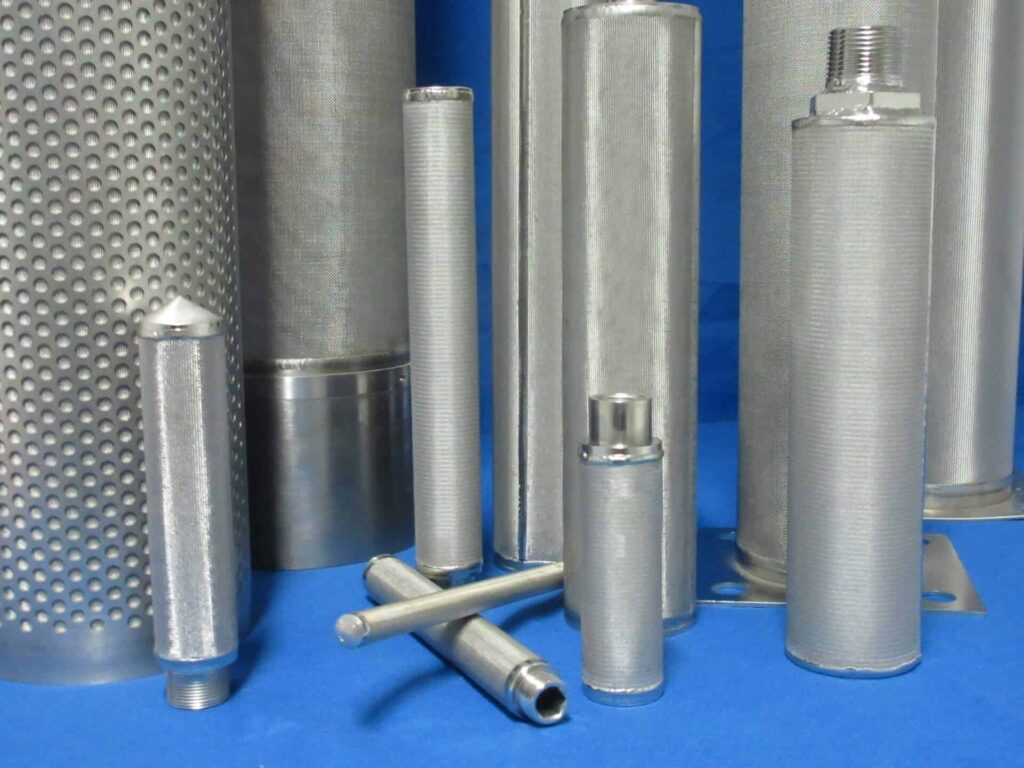
In today’s industrial landscape, filtration plays a crucial role in ensuring the purity, performance, and safety of products and processes. Among the various filtration technologies, Sintered Metal Filters stand out due to their durability, high-temperature resistance, and excellent particle retention capabilities. These filters are widely used across industries such as chemical processing, pharmaceuticals, oil & gas, food & beverage, and environmental engineering.
But how are these advanced filters actually made? In this article, we explore the complete manufacturing process of sintered metal filters — from material selection to final quality inspection.
What Are Sintered Metal Filters?
Before diving into the process, it’s important to understand what sintered metal filters are. They are porous filtration elements made by fusing metal powders under high temperature and pressure without melting them. The result is a rigid, highly durable filter with uniform porosity, capable of handling aggressive environments where traditional filters might fail.
Step-by-Step Manufacturing Process:
1. Raw Material Selection:
The manufacturing journey starts with selecting high-quality metal powders. Common materials include stainless steel, bronze, titanium, and Hastelloy, chosen based on the application and required chemical compatibility.
The metal powder must have consistent particle size and composition to ensure even porosity in the final product. Particle size distribution directly impacts filtration efficiency and flow rate, so this step is critical.
2. Powder Blending:
In this stage, metal powders are blended to achieve uniform distribution. If custom filter properties are needed, additional elements or alloys might be added. The goal is to ensure that the mixture will sinter evenly and produce a consistent structure.
Advanced mixers are used to blend the materials thoroughly without causing contamination or particle segregation.
3. Cold Pressing (Compaction):
The blended powder is poured into a mold (die) and compacted using a hydraulic or mechanical press. This process, known as cold isostatic pressing (CIP) or uniaxial pressing, shapes the material into the desired form — usually cylindrical, disc, or tubular — under very high pressure.
The green compact (the unsintered part) must be structurally stable enough to be handled and moved to the next stage.
4. Sintering:
This is the heart of the process. The green compacts are placed into a controlled-atmosphere furnace and heated to a temperature just below the metal’s melting point. The sintering process causes the particles to bond at contact points, forming a solid, porous structure.
The sintering temperature, time, and atmosphere (often hydrogen or vacuum) are precisely controlled to produce the required porosity, strength, and flow characteristics.
5. Post-Sintering Treatments:
Depending on the application, several post-processing steps may be applied:
- Heat Treatment – to enhance mechanical strength
- Welding or Machining – to add end caps, fittings, or specific dimensions
- Surface Finishing – to clean and polish the surface
- Cleaning and Degreasing – to remove any contaminants from the sintering process
At this point, the sintered metal filter takes on its final form and is ready for inspection and testing.
Quality Control and Testing:
Every NESIA Filter undergoes rigorous quality checks to ensure it meets performance and safety standards. Some key tests include:
- Bubble Point Test – Measures the pore size and verifies filter integrity
- Flow Rate Testing – Ensures the filter meets pressure drop and flow rate specifications
- Dimensional Inspection – Confirms the filter matches design tolerances
- Chemical Compatibility – For filters used in corrosive environments
These tests are essential to guarantee reliable operation, especially in critical applications like sterile filtration or high-temperature gas filtration.
Advantages of Sintered Metal Filters:
The unique manufacturing process offers a wide range of benefits:
- High Mechanical Strength – Can withstand high pressure and backflushing
- Temperature & Corrosion Resistance – Suitable for extreme conditions
- Long Service Life – Reusable and easy to clean
- Precise Filtration – Uniform pore structure ensures consistent performance
- Customizable Design – Tailored porosity, shapes, and sizes available
These advantages make sintered metal filters ideal for industries demanding robust and high-performing filtration solutions.
Applications Across Industries
Because of their strength and versatility, sintered metal filters are used in:
- Chemical and petrochemical filtration
- Steam and gas filtration
- Food and beverage processing
- Pharmaceutical manufacturing
- Water treatment and desalination plants
- Hydraulic and lubrication systems
From trapping solid particles in aggressive fluids to sterilizing gases in biotech labs, these filters are trusted across high-performance applications.
Final Thoughts:
The manufacturing process of sintered metal filters is a perfect blend of science, engineering, and precision. Each step — from powder selection to final testing — plays a vital role in creating filters that are not only efficient but also exceptionally durable.
For industries that demand reliability under extreme conditions, investing in quality sintered filters is a smart long-term choice. Trusted manufacturers like NESIA Filter provide tailored solutions that meet the highest standards of performance and durability.
By understanding the process behind these advanced filters, you can better appreciate the technology that supports modern filtration challenges — and make informed decisions when choosing the right solution for your application.