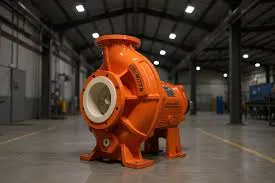
Handling nitric acid demands a pump that can survive corrosion, high oxidation, and thermal stress. Nitric acid pumps play a pivotal role in fertilizer plants, nitration units, acid recovery systems, and chemical synthesis. Yet many installations still rely on standard metal pumps, which fail prematurely.
As a plant engineer or operations lead, you face leaks, unplanned downtime, and safety risks. You want a pump that lasts, costs less over time, and gives you peace of mind. In this guide, we walk you through the challenges of nitric acid handling, what design features make a difference, real applications, and how advanced engineering delivers robust performance.
Understanding the Challenges of Pumping Nitric Acid
Why Nitric Acid Is Among the Harshest Fluids
- Nitric acid is a strong oxidizer and reacts aggressively with many metals, especially in concentrated form.
- It attacks protective oxide layers on stainless steel, leading to localized corrosion, pitting, or even surface embrittlement.
- Impurities like chlorides or heavy metals further accelerate degradation.
- Temperature amplifies risk: higher temperatures boost reaction rates and stress on materials.
- Vapors and off‑gassing add to containment challenges, particularly where sealing is imperfect.
A pump that survives in a milder chemical service may still fail rapidly under nitric acid duty.
Common Failure Modes in Nitric Acid Pumps
| Failure Mode | Description | Risk/Consequence |
| Pitting/crevice corrosion | Localized attack in joints, flanges, bolt holes | Weakens structure, causes leaks |
| Seal degradation & leakage | Seal materials attacked by acid or heat | Loss of containment, safety hazard |
| Stress corrosion cracking (SCC) | Cracks under simultaneous tensile stress and corrosion | Sudden failures, safety risk |
| Thermal fatigue | Micro-cracks from repeated heating/cooling cycles | Crack propagation, wall thinning |
Understanding which mode is likely in your system helps you design and select better pumps.
Material Selection: The Key to Safe Nitric Acid Pumping
Choosing a resistant and durable material is the foundation of any pump design for nitric acid service.
Limitations of Metals and Traditional Options
- Even high‑grade stainless steels may develop crevice corrosion or SCC under nitric acid.
- Neutral or chloride impurities reduce their corrosion resistance further.
- Cast iron or carbon steel is rapidly consumed in nitric environments.
- Standard polymers or FRP may swell, degrade, or leach under oxidation or heat stress.
- Liners on metals often fail at seams or interfaces, exposing bare metal.
These materials often only last months under rigorous acid duty, leading to frequent replacement.
When to Consider Non‑Metallic or Advanced Polymers
You should move toward advanced polymers or lined polymer designs when:
- Nitric acid concentration exceeds 10–20%
- Process temperatures push above standard polymer limits
- Safety and leak control are regulatory priorities
- Continuous operation is critical
In such cases, a well‑chosen polymer system can outperform metals in both lifetime and reliability.
Chemitek’s PVDF and PFA‑Based Pump Designs
- PolyPrime™: A high‑purity PVDF blend optimized for acid resistance and minimal porosity.
- PolyGrif™: Enhanced PVDF composite offering improved impact and fatigue resistance.
- The pump body often uses a reinforced polymer liner bonded to structural ribs or a cage to handle pressure.
- TruTrapezoid™ impellers: Impeller geometry that avoids thin, sharp edges and balances stress across surfaces.
- Materials are selected to match your acid concentration, temperature, and impurities.
With these design choices, a nitric acid pump can run reliably for multiple years with minimal intervention.
Safety Features Every Nitric Acid Pump Should Include
Safety is non-negotiable when working with nitric acid. The pump must include features that detect, contain, and mitigate leaks or failures.
Containment and Leak Protection
- Fully enclosed casings prevent acid mist from escaping into the environment.
- Secondary containment barriers (double shells or drip pans) catch leaks before they spread.
- Buffer chambers or barrier seal zones capture leaks in a controlled area.
Sealing and Isolation Strategies
- Use seal materials compatible with nitric acid (e.g. PTFE, FFKM) capable of resisting oxidation and heat.
- Incorporate buffer fluids or purge systems to relieve stress on the primary seal.
- Design seal chambers with flush ports so any leaked acid is purged away safely.
Isolation from Motor and Internals
- Use nonmetallic couplings or bellows to prevent acid ingress into the motor shaft.
- Seal all joint surfaces to prevent vapor or acid penetration.
- Provide dedicated drain ports or purge vents to relieve accumulated pressure safely.
Chemitek’s Design Enhancements for Operator Safety
- Double-seal setups with intermediate buffer zones act as early warning systems.
- Leak-detection ports allow visual checks or sensor placement.
- External jackets isolate pump surfaces, buffer temperatures, and reduce exposure.
- Modular construction allows replacing seal modules without removing the entire pump.
When safety is built in, you reduce risk to personnel and plant infrastructure.
Efficiency Matters: Designing for Long-Term Performance
Beyond surviving nitric acid, a pump must perform efficiently. Poor design erodes margin and increases operational cost.
Flow, NPSH, and Cavitation Considerations
- Maintain adequate inlet pressure (NPSH) to prevent vapor formation.
- Impeller clearances should be optimized to prevent recirculation.
- Flow path design must minimize dead zones, eddies, or turbulence that amplify corrosion or wear.
Controlling Abrasion and Corrosion Interplay
- Use wear-resistant liners or sacrificial zones in high‑stress areas.
- Avoid sharp edges or sudden geometry changes that cause erosion.
- Provide flushing paths to remove corrosive deposits or sludge buildup.
Motor and Impeller Optimization
- Match the motor to the pump curve to prevent overload and inefficiency.
- Use balanced impellers to reduce vibration and wear.
- Periodically rebalance rotating parts to minimize misalignment-related wear.
Priming and Stability in Acid Systems
- Define priming pot systems to guarantee startup even under low suction head.
- Include anti‑cavitation features to maintain flow stability at low load.
- Use bypass or recirculation loops to handle transients smoothly.
Modular Designs for Easy On‑Site Service
- Use standardized modules for seals, impellers, and liners.
- Incorporate cartridge seals for fast swap-outs.
- Provide inspection ports and removable covers for easy checks.
These design features deliver efficient, low-maintenance, and reliable nitric acid service.
Real-World Applications of Nitric Acid Pumps
Seeing how nitric acid pumps are used in practice helps bring design principles into sharp focus.
Use in Nitration, Fertilizer, and Mixed-Acid Systems
- In fertilizer production, nitric acid combines with ammonia to form ammonium nitrate. Pumps handle concentrated and dilute streams.
- In nitration reactions, acid mixtures (e.g. nitric + sulfuric) require pumps that tolerate mixed acids, temperature swings, and abrasive byproducts.
- Recovery or recycle loops often handle spent acid streams containing impurities and particulate matter.
Pumps for Dilute vs Concentrated Nitric Acid Streams
| Stream Type | Design Emphasis | Operating Challenge |
| Dilute (<10%) | Cost-effective polymeric or lined metal design | Lower oxidation, but fouling and contamination risk |
| Concentrated (>50%) | 100% fluoropolymer construction | High oxidative stress, temperature, and vapor |
The pump for each stream must be tailored accordingly.
Integration into Existing Process Systems
- Retrofitting existing pipelines demands careful alignment and space planning.
- CIP (clean-in-place) systems or acid flush lines must integrate seamlessly.
- Instrumentation, valves, and sensors must be compatible with acid exposure.
- Startup procedures and controls need to handle high-reactivity fluid transitions.
Case Examples of Chemitek Pumps in High-Corrosion Sites
- In an acid dosing unit, the lifetime of the pump increased from 6 months to over 36 months.
- In a fertilizer plant, overall uptime improved by 25% after switching to a robust acid-design pump.
- During safety audits, no leaks or corrective actions were raised in three straight cycles after the upgrade.
These are not theoretical claims; they reflect improved safety, productivity, and cost savings in real operations.
Choosing Chemitek for Nitric Acid Pumping: Key Takeaways
When selecting a nitric acid pump, keep these critical points in mind:
- The material must match your acid’s concentration, impurities, and temperature range.
- The design impeller geometry, wall support, sealing, and modularity matter as much as the material choice.
- Safety features like secondary containment, leak detection, and buffer seals are not optional.
- Efficiency and modular construction significantly reduce operating costs and downtime.
- Long-term performance and maintenance support are essential to realize full value.
A pump that blends safety, efficiency, and durability is not a luxury—it’s a necessity in nitric acid service.